
Share this link via
Or copy link
W hen the subject of veganism arises during social gatherings, there's often (at least) someone who asks, “But what if you live in Greenland? Surely you couldn’t be vegan there.”
While most people live in regions with easy access to a variety of plant-based foods and vegan options, and many use the Greenland argument as a way to justify avoiding a vegan lifestyle, the question remains - is it possible to be vegan even in such remote and harsh environments?
Veganism is fundamentally about rejecting exploitation and violence towards animals when it comes to food, clothing, travel, entertainment, sport, etc. So, the real question is - can we choose a compassionate lifestyle even in one of the most isolated and challenging places like Greenland?
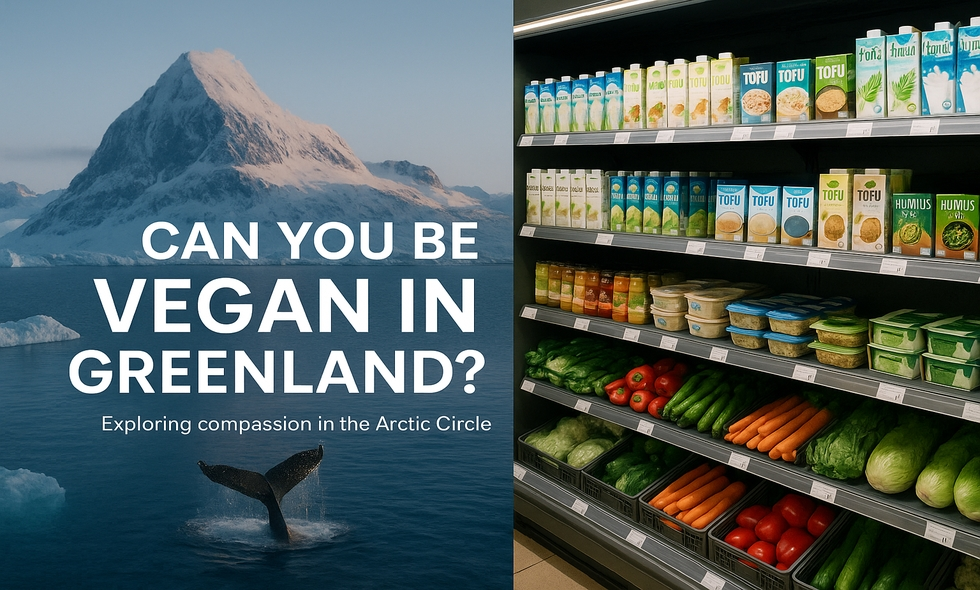
Maybe a hundred years ago it would be unthinkable, but today things are different. You can buy fresh produce, frozen veggies, and fruits as well as whole foods like rice, pasta, and beans in stores even in such remote places. You can also find imported personal body care products like face creams, body lotions, shampoos, and hair styling products, as well as cell phones, laptops and all the other tech goodies we regularly use to check our instagram and facebook accounts.
Vegan traveler Melissa Cherry spent several months living in Greenland back in 2019. She said “in Nuuk, you will be able to eat really well as a vegan. Most of the restaurants and cafés have great vegan/vegetarian menus, and it’s also easy to cook exciting vegan dishes for yourself. The supermarkets have a vast variety of vegan foods and you can even find vegan cheese, yogurt, chocolate, and ice cream!”
Vegan activists that visited Greenland even found fresh green lettuce, carrots, and potatoes thrown in the garbage behind the store. This tells us availability isn’t always an issue and that people perhaps prefer to buy meat instead.
Smaller villages in the country can be a challenge, says Melissa. “You can still find whole foods in stores, but you would have to make your own vegan milk, yogurt, and burgers.” Melissa even provided a very useful list of vegan foods you can find in Greenland. So here it is!
Nuuk
These long lists of foods and products show us there are quite a lot of vegan options that one can choose from. If someone desires vegan dairy and meat substitutes that are not available, there are tons of delicious recipes online one can make at home using simple ingredients, and for a much cheaper price. So if someone wants to go vegan, there is always a way.
According to happy cow - a mobile app and website that lists vegan friendly restaurants, there are a few places one can dine as a vegan. Three most popular ones are Inuit Cafe, Cafe Esmeralda, and Cafetuaq.
Historically, traditional diets in these cold, remote regions consisted mostly of meat, fish, and tallow. They included reindeer, muskox, lamb, sheep, seal, whale, and various fish species. While today's diets remain very similar, much of the hunting has been replaced by the animal industries and slaughterhouses that greenlanders take pride in. Many even see these modern practices as the future of their country.
Though people often value their traditions and want to respect their ancestors by continuing with the same practices, when it comes to diet, one might reconsider such choices.
Harsh conditions that were forcing people in ancient times to rely only on animal products came with a high cost. Namely, the Inuit had the shortest lifespan of 43,5 years on average. Their bone density was around 12% lower than in people in the West, and many suffered from advanced stages of atherosclerosis and osteoporosis. It was even found that their mummies had the same issues.
This tells us our bodies haven’t adapted to the high meat diet, even after doing it for centuries. Our ancestors may not have had a choice, but we do. Even if it sometimes requires a bit of creativity and a slightly higher budget, it is worth it in the end. After all, there is no greater wealth than health.
When it comes to imported products like fruits and veggies, many get reluctant to buy them with the best intention of protecting the environment and decide to opt out for local food, which in this case usually means animal flesh.
But the data shows something different. Multiple studies have confirmed that up to 20% of global emissions come from animal agriculture.This industry contributes to more greenhouse gas emissions than all forms of transportation combined. One that is very problematic is methane that animals produce, which is the cause of over 25% of global warming.
Even when we buy local animal products, most of the food emissions come from processes on the farms, or from land use change, so it wouldn't make much of a difference.
University of Oxford’s Joseph Poore, who led the most comprehensive analysis of the damage farming does to the planet concluded that - “A plant based diet is probably the single biggest way to reduce our impact on planet Earth, not just greenhouse gasses, but global acidification, eutrophication, land use and water use. It is far bigger than cutting down on our flights or buying an electric car”.
Whale hunting and consumption have a long history in Greenland and are a significant part of their culture, heritage, and economy. While it used to be a necessity for survival, whale meat is still a regular part of the local diet today.
Meat from these majestic and otherworldly beings has also been actively promoted to tourists as a local delicacy. You can find traditional dishes like mattak - made with whale skin and blubber, tartarmiut - a greenlandic version of steak tartare, or arfivik - smoked whale meat, on menus in most restaurants.
Meat from minke, fin, narwhal, and the most widespread humpback whale is available for purchase in large, modern, well-stocked supermarkets. You can also buy narwhal jewellery and orca tooth necklaces on sale at various outlets, with no mention of export requirements under the Convention on International Trade in Endangered Species(CITES).
According to authorities, whaling practice is subjected to regulations and quotas to ensure ‘the sustainable management of whale populations’. But there are concerns about the ethics of it, particularly in the context of global conservation efforts.
New EIA research has uncovered that over 100,000 small cetaceans - including various species of whales, dolphins, and porpoises - have been slaughtered in poorly regulated hunts near Greenland during the past 3 decades.
Seven cetacean species have been targeted, but only two are officially regulated leaving the majority unprotected.
By eating the traditional Greenland diet, we support these cruel and outdated practices that have detrimental consequences for the animals, the environment, as well as the health of people.
Instead of eating their flesh, we can rather get to know them by joining one of many whale watching tours during summer where we are likely to spot humpback whales, fin whales, and minke whales. But even rarer species can be seen in Greenland like beluga whales and narwhals, blue whales and orcas. ‘Seeing these gentle giants in Greenland and hearing the breathtaking sound of them exhaling at the water’s surface is something you will never forget.’ say those who have experienced it first hand.
When it comes to reindeer, many of us first think of the festive season - warming our hands with hot cups of cacao, singing Christmas carols, and of course, kids' favorite figure - Santa Claus delivering presents with the help of his faithful reindeer. That’s the familiar story we grow up with.
However, it can be quite surprising for Westerners to realize how children in other cultures might grow up hearing Santa Claus tales and watching Christmas movies, and then having dead body parts of Dasher, Dancer, Donner, Blitzen, and others on their plates. Yet, this paradox is similar to how kids in the West grow up admiring characters like Ferdinand the Bull or Nemo the Fish, and still eating them on a daily basis.
Even though we're not kids any more, I think it’s safe to say we’d rather watch reindeer and other animals in the wild roaming free and warming our hearts to their very sight, without needing to harm them for survival. And thankfully, today we have that option.
So the next time someone asks you if a person can be vegan in Greenland, you can confidently tell them it’s more than possible! You might even suggest going whale watching together and marvel at the unique experiences this remote island has to offer.