
Share this link via
Or copy link
S Many claim that humans are at the top of the food chain. So are we a natural born apex predator like a lion? As we discussed in the first part, when it comes to anatomy, biology, and physiology, we are definitely not. But how do we stand when it comes to our senses and psychology? Keep reading if you want to find out more.
When it comes to diet, every species is naturally attracted to certain types of food. Even if no one would tell us what is good for us, we would automatically pick food that would appeal to us the most.
Carnivores are attracted to 'ugly' food - - animals that are sick, injured, or defected. They even have the ability to detect metabolic disorders such as diseases, tumors, degeneration and the like with their acute senses and target precisely such individuals, because they are easier to catch. This also plays an important role in keeping nature in balance. By removing the diseased ones, predator animals keep the gene pool of herbivore species strong, healthy, and resilient. We, on the other hand, are attracted to beautiful, fresh, healthy food and vivid colors - strong pigments in colorful fruits and vegetables like a beautiful red apple, juicy peach, plump tomato or the bright yellow turmeric. These intense colors attract us for a reason.They are phytonutrients and antioxidants that are very healthy and essential for us. When people would hunt, they would use weapons because our biology wasn’t enough by itself, and they would kill the most beautiful and strongest individuals, following their innate attraction to beauty, thereby weakening the gene pool and endangering the survival of other species.
Carnivores can definitely see us in the dark. They have excellent night vision, more than 6x better than ours. They have significantly more rods than cones in their retina. This makes sense because nature's hunters mostly hunt at night when herbivores are asleep and it’s easier to catch them without expending a lot of energy.
Carnivores have dichromatic vision, which means they don’t see colors well and have poor resolution - they can’t see details. So maybe they won't see your face clearly, but they'll definitely know you're there. Since they don't eat plants that contain pigments, colors are not very important to them, while they are essential to us.
These predators are able to detect even the slightest movement. You can see this when you for example wave a string in front of a cat, and he/she catches every movement without much effort, or play with little flies in the air that we don't even see. This ability is ideal for hunting.
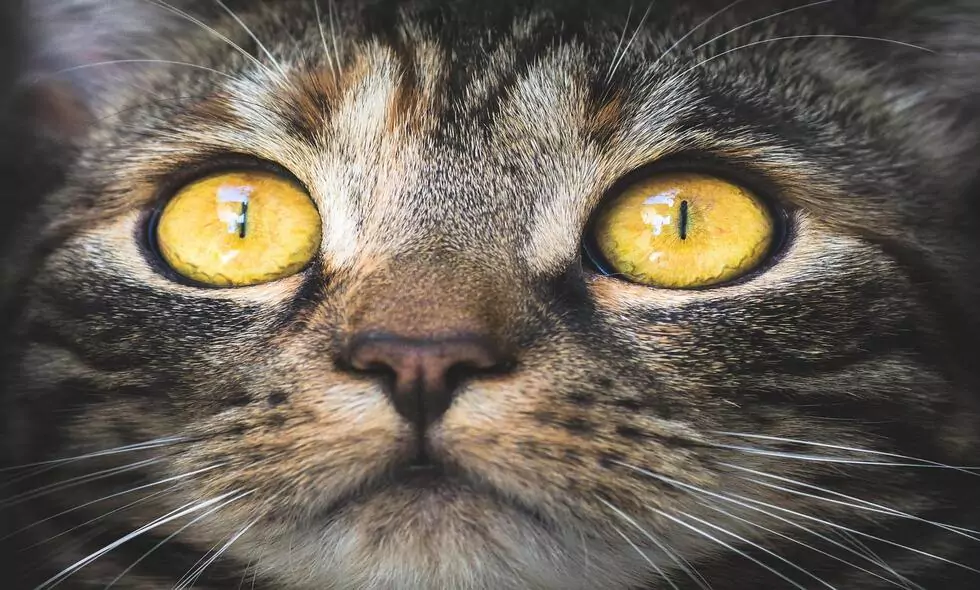
Carnivores have pupils that narrow vertically, which allows them to better assess depth, and adapt to bright daylight or weak night light. That is something we don't have. Our pupils narrow and dilate slightly and have a round shape instead of a vertical line when constricted.
In humans, the eyes have more cones than rods, and our vision is trichromatic, which allows us to see a wide range of colors. This is important for us in order to recognize plants like fruits and veggies with the strongest pigments and the most nutrients.
We have good eyesight and see clearly, but at night it's difficult for us to navigate without at least a bit of light. If we had the night vision of carnivores, we wouldn't bump into things when going to the bathroom in the middle of the night.
You've probably noticed how cats’ and dogs' eyes shine in the dark, especially when you point light at them. It seems as if they have flashlights there. This is because, like all carnivores, they have a reflective layer in the back of their eyes called the tapetum. This enables them to see better at night and hunt more easily. Only carnivores and omnivores such as bears and dogs have this layer and shine in their eyes.
Herbivores don't have this because they don't need it. Like us, they are diurnal animals that sleep at night.
Interestingly, humans genetically never had this reflective layer in their eyes and such special ability, even in the earliest stages of human development as a species, which would also suggest that we were never born to hunt animals.
When it comes to smelling things, we're not the best at it. Sure, we can notice when someone puts on a perfume, detect a food that went bad in the fridge or admire a beautiful sweet scent of roses from the garden. But catching a wif from a wild animal a mile away, that's not in our arsenal of weapons. And you can't hunt on a daily basis if you can't do that.
That's why the sense of smell in carnivores is up to 100,000 times better than ours, and they actually Can smell their prey from a great distance without much effort. But it goes beyond that. They are able to find animals with metabolic disorders like infections, tumors, cancers, etc., because carnivores and omnivores don’t hunt random individuals, as it was believed till now. They target precisely the sick ones because they are much easier to catch and thus less energetically tasking.
Research on wolves showed that 80% of their prey had cancer or some metabolic disorder. Although it is disgusting to us, they also eat tumors and this gives them the same energy as if they had eaten a healthy animal.
Today, dogs are used to sniff out disease in humans because they can detect it far before scanners and tests.
Carnivores and some omnivores have ears that can turn like a radar, thus picking up sounds from almost any direction. They hear frequencies of 30-80 kHz, which is why they can detect prey from up to 1,5 miles away.
Our ears can't turn and we don't hear that well. Our average is about 1-5 kHz - we hear at around 22 yards when someone is talking to us, and if they shout, we can hear at a distance of 110 yards. No animal would shout at us so that we know they are there, and it’s even less likely that they would come 20 yards from us so we could kill them more easily.
Carnivores have 470 taste receptors on their tongues, while we have an average of 10,000. I guess if your natural diet is guts, tumors, and blood, you don't want or need to ‘feel it’ to the fullest.
Our exceptionally wide range shows how important taste is to us and how it's adapted for many different types of food. This makes sense when we know that there are 80,000 edible plants. Maybe this could also explain why we have gourmet restaurants with 4 and 5 Michelin stars in cities around the world, and chefs creating masterpieces with combining different ingredients and flavors for people to enjoy.
Our tongue doesn’t have receptors for proteins and fats, whereas carnivores like lions and tigers do. But we do have receptors for salty, sweet, spicy... That's why we add various spices while cooking or baking meat to make it tasty. The truth is the flavors we love actually come from plants.
We also have taste buds on the soft palate and in the pharynx, which allows us to have a greater range of taste. This is something that carnivores don't have.
You have never seen a wildlife documentary where a lion adds spices to an antelope before eating it to make it tastier. They also don’t use a fork and a knife to chop them up - they have teeth and claws for that. They don’t thermally process their prey for several hours either so they can eat it. Carnivores eat everything - eyes, tongue, organs, anus, skin, the whole animal. They don't just eat muscles like we do and they don't skip something because it's 'disgusting', like it is to us.
We humans are disgusted by the sight of a dead animal, guts, and blood. We don't have the urge to throw ourselves on a carcass by the side of the road or an animal on the kill floor of a slaughterhouse and eat it raw.

If we brought a lion or a wolf to the slaughterhouse, they would salivate at the scenes of killing and blood, the same ones that disgust us and make us feel sick. In fact, we are traumatized by them. Even an omnivore like a bear would enjoy it and get down to business.
This is precisely why taking footage and filming in slaughterhouses and industrial animal farms is prohibited, in some countries even by law, so that the truth doesn’t come out. Because when we see such things, we want to help the animals and save them. We don't come there with a knife and a fork because we've worked up an appetite.
Animals are cut up into smaller pieces and unrecognizable shapes, nicely washed and packaged, so that we forget it was once a living being. Pictures of happy animals are often added to the packaging to make the trick even better. Industries know that our true nature is compassion and that we don’t want to harm another being. Carnivores, even omnivores, have no problem with this. Old or young, healthy or sick, everything is welcomed on the menu.
When you offer a human baby a juicy, colorful piece of fruit to eat, or a bunny, they will always choose fruit. We were not born with a preference for kebabs, ham, and cheese, we were accustomed to these tastes from a young age.
Even though most of us grew up on a diet that included animal foods, that's not an obstacle to make the change and go back to the foods that are natural to us and are a much healthier choice. The flavors we are used to can easily be reproduced with the help of spices and plants. After all, they are the ones that gave meat dishes their taste.
I hope this article brought some clarity on what is best for us to eat, and inspired you to make positive changes for your health and overall well-being.
When you offer a human baby a juicy, colorful piece of fruit to eat, or a bunny, they will always choose fruit. We were not born with a preference for kebabs, ham, and cheese, we were accustomed to these tastes from a young age.
Even though most of us grew up on a diet that included animal foods, that's not an obstacle to make the change and go back to the foods that are natural to us and are a much healthier choice. The flavors we are used to can easily be reproduced with the help of spices and plants. After all, they are the ones that gave meat dishes their taste.
I hope this article brought some clarity on what is best for us to eat, and inspired you to make positive changes for your health and overall well-being.
When you offer a human baby a juicy, colorful piece of fruit to eat, or a bunny, they will always choose fruit. We were not born with a preference for kebabs, ham, and cheese, we were accustomed to these tastes from a young age.
Even though most of us grew up on a diet that included animal foods, that's not an obstacle to make the change and go back to the foods that are natural to us and are a much healthier choice. The flavors we are used to can easily be reproduced with the help of spices and plants. After all, they are the ones that gave meat dishes their taste.
I hope this article brought some clarity on what is best for us to eat, and inspired you to make positive changes for your health and overall well-being.
When you offer a human baby a juicy, colorful piece of fruit to eat, or a bunny, they will always choose fruit. We were not born with a preference for kebabs, ham, and cheese, we were accustomed to these tastes from a young age.
Even though most of us grew up on a diet that included animal foods, that's not an obstacle to make the change and go back to the foods that are natural to us and are a much healthier choice. The flavors we are used to can easily be reproduced with the help of spices and plants. After all, they are the ones that gave meat dishes their taste.
I hope this article brought some clarity on what is best for us to eat, and inspired you to make positive changes for your health and overall well-being.